You notice it while hanging a picture: a thin line running diagonally up from the corner of a door frame. Or a hairline crack above the living room window that was not there last summer. These are some of the most common wall flaws in Florida homes, and the good news is that many hairline cracks can be fixed in a single afternoon.
This guide covers the fast method for small cracks – and, just as importantly, how to tell when a quick fix will not last.
First, decide if it is really a quick-fix crack
A crack is a good candidate for a same-day repair if:
- It is thin – narrower than a credit card's edge
- It is short and runs from a door or window corner, or sits in the middle of a wall
- It has not reappeared after a previous repair
- The wall around it is flat, dry and solid
Cracks above doors and windows usually come from small, normal movement in the house. Corners of openings are where stress concentrates, so they crack first.
Skip the quick fix and use a taped repair if the crack is wider, keeps coming back, follows a seam for a long distance, or has edges that are raised or uneven. Our step-by-step guide to taped crack repair covers that method.
What you need
- A flexible putty knife (a narrow one and a wider one, if you have them)
- Fast-setting joint compound (the powder you mix with water) or a lightweight premixed spackle for very fine cracks
- A utility knife
- Fine sanding sponge
- Damp cloth
- Primer and matching paint
Fast-setting compound is the key to a quick job. It hardens by chemical reaction rather than drying in the air, so it sets reliably even when the house is humid.
The quick method
- Open the crack slightly. Run the tip of a utility knife along it to make a shallow V. This removes loose paint and gives compound something to grip.
- Clean the area. Wipe away dust with a barely damp cloth and let it dry.
- Mix a small batch. Mix only what you can use before it sets. It should be about the consistency of thick yoghurt.
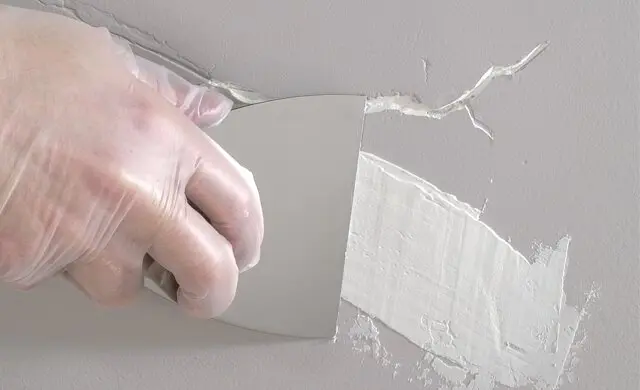
- Press compound into the crack. Hold the knife at a low angle and push the compound in, then scrape it flat.
- Feather a thin second pass. Once the first pass has set, apply a slightly wider, very thin coat to blend it into the wall.
- Sand lightly. Use a fine sponge and a light touch. You are smoothing the edges, not removing the patch.
- Prime, then paint. Spot-prime the repair so it does not flash through the paint, then paint the wall section, ideally from corner to corner.
Shortcuts that backfire
- Caulk on a wall crack. Flexible caulk belongs on trim joints, not flat drywall. It stays rubbery, shows through paint and is hard to sand.
- Painting straight over spackle. Unprimed compound absorbs paint differently and leaves a dull or shiny patch.
- One thick coat. Thick compound shrinks and can crack again, especially as Florida humidity rises and falls.
- Heavy sanding. It digs into the paper face of the drywall and creates a fuzzy, uneven surface.
Helping the repair last
Hairline cracks often return when a home's moisture and temperature swing a lot. In Florida, that usually means:
- AC units switched off for long periods in summer
- Rooms closed off with no air movement
- Bathrooms without a working exhaust fan
Keeping the house at a steady temperature and humidity helps repairs stay invisible. If a crack returns quickly in the same place, it is a sign the area needs tape reinforcement – or that something else is moving.
When to call a professional
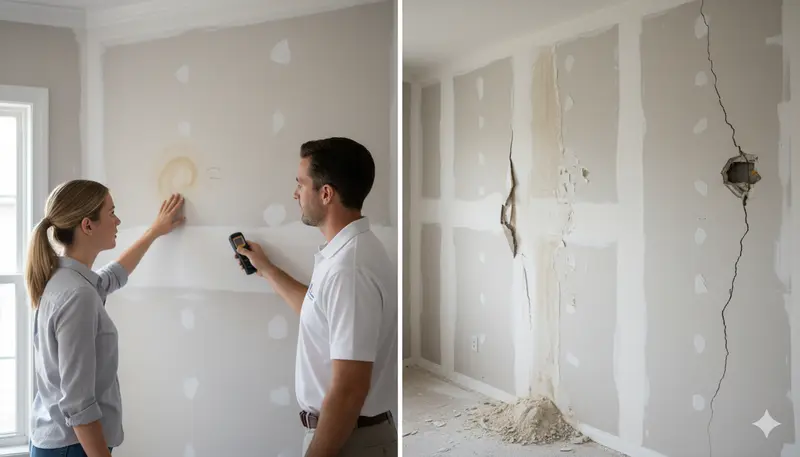
Call in help if you see:
- Cracks wider than a hairline or with one side higher than the other
- Doors or windows that have started to stick along with new cracks
- Stains or soft spots around the crack, which point to moisture
- Cracks across a ceiling, especially along seams
- Cracks in plaster, common in some older homes, which need different materials
Our seam and crack repair service handles these, and if you just want the walls ready for a fresh coat, our painting prep team can fill, sand and prime every crack in the room. We serve homes across Pinellas County and the wider Tampa Bay area – text a photo to 727-242-8500 for a written estimate, usually within the hour.