
After the AC Crew Leaves
Drywall Repair After HVAC Installation and Ductwork Changes
A new air handler, relocated ducts or a bigger return grille almost always leaves openings in ceilings and walls that the HVAC crew does not finish. We close abandoned registers, resize cut-outs, repair condensation-stained ceilings and match the texture overhead so the new system is the only thing you notice.
- Veteran-owned
- Background-checked techs
- 1-year written warranty
- Text-a-photo quotes
Free estimate in about an hour
- Text a photo to 727-242-8500
- Written quote = final price
- HEPA dust control on every job
- Walkthrough before you pay
Why HVAC work leaves holes behind
Heating and cooling contractors are licensed to move air, not to finish drywall. When a system is replaced or redesigned, the openings in your ceiling rarely line up with the new layout, and the crew's job ends once the equipment runs.
Typical leftovers we are called in for:
- Abandoned supply registers where a duct run was rerouted or removed, leaving a rectangular hole or a grille that now blows nothing.
- Return grilles moved or enlarged for a higher-capacity system, leaving a ragged oversize cut or a half-covered old opening.
- Access holes cut to reach a duct boot, a damper or a line set inside a wall or soffit.
- Closet and hallway ceilings opened to swap an air handler or drain pan.
- Thermostat relocations that leave a wire hole and a ghost of the old base plate.
- Mini-split installs where the line set penetration was cut larger than needed or in the wrong spot.
None of these are difficult for a drywall specialist, but each one sits overhead or on a visible wall, so a sloppy patch is noticed every day.
Attic air handlers, condensation and ceiling stains
In many Florida homes the air handler and much of the ductwork sit in a hot attic above the ceiling. That arrangement produces a specific kind of ceiling damage.
An air conditioner pulls a steady stream of water out of humid indoor air. That water should drain away through a condensate line. When the line clogs with algae, the drain pan overflows or rusts through, and water spreads across the ceiling drywall below. Separately, a poorly sealed or under-insulated duct, or a register boot with gaps around it, meets hot attic air and sweats, dripping onto the back of the ceiling right around the vent. Both show up as brown rings, bubbled paint or sagging board near a register or under the unit.
The cause has to be fixed by a licensed HVAC contractor first, whether that means clearing the drain line, replacing a pan, adding a float switch or sealing and insulating the boot. We do not perform HVAC work. Once the source is dealt with and the area has dried, we repair the drywall.
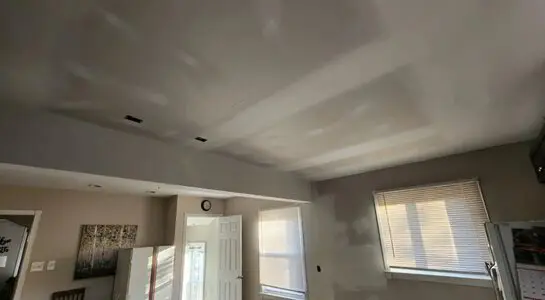
How we patch ceilings overhead
Confirm the cause is fixed
We ask what the HVAC contractor did and check the board with a moisture meter. A patch over damp drywall will stain again and can soften.
Cut back to sound board
Stained but firm drywall can be sealed and kept. Soft, sagging or crumbling board is cut back in a clean rectangle to solid material, often to the nearest joists.
Add backing
Overhead patches need support. We fasten wood cleats or furring across the opening, or screw directly to framing, so the new piece cannot sag or crack along its edges.
Fit, tape and fill
A new piece of drywall is screwed in flush, seams are taped with setting compound that resists cracking, and the joints are built up and feathered wide for an overhead light angle.
Seal and match the texture
Any remaining stain is locked in with a stain-blocking primer, then the original ceiling texture, whether knockdown, orange peel, smooth or acoustic, is reproduced and primed.
Common HVAC-related drywall repairs
Closing an old register
Once the duct has been capped above by your HVAC contractor, the opening is backed, filled with a new piece and blended into the ceiling so you cannot tell a vent ever existed.
Resizing a return opening
Cut-outs that are too big for the new grille are reduced to the exact size, so the grille sits tight against the ceiling without visible gaps at the edges.
Wall chases and soffits
Where duct or refrigerant lines were run through a wall or soffit, we patch the cut-outs, tape and finish them and match the room's wall texture. Building new soffits is carpentry for your HVAC or general contractor.
Air handler closet repairs
Cracked corners, dented walls and water-stained ceilings around the equipment closet are repaired and sealed, often with moisture-resistant board.
Attic access hatches
Damaged or oversize scuttle openings are squared up and finished cleanly around the new trim.
Thermostat moves
The old mounting holes and paint shadow are filled, textured and primed so the wall is ready to paint.
Timing the drywall work around your HVAC project
A little planning keeps the ceiling from being opened twice. Ask your installer for the final register and return locations before they cut, and whether any existing openings will be abandoned. Old ducts should be removed or capped and sealed in the attic before we close a hole, otherwise conditioned air leaks into the cavity and can cause the same sweating that stains ceilings.
If the HVAC crew leaves several openings, we can close them all at the same visit as other repairs so the painter has one clean surface to work on. For a mini-split, ask the installer to drill the line set hole only as big as the sleeve needs; a tidy hole is far easier to finish than a broken edge.
One more check matters in older houses. If a ceiling with acoustic texture is going to be cut for new vents and that texture may date from before the mid-1980s, have it tested for asbestos before the HVAC crew starts cutting. Our popcorn ceiling removal page explains how testing works and what we can do once a ceiling is cleared.
Patch it or replace the section?
Seal and paint only when a stain is dry, the board is firm and the paint has not bubbled.
Patch when the damage is limited to a cut-out, a vent hole or a small soft spot around a register.
Replace a full section when the drywall sags between joists, the paper has delaminated or water has soaked a wide area.
Ask about insulation when the attic side got wet. Wet insulation above a ceiling should be removed and replaced before we close up, so it does not hold moisture against new board.
Preparing for your repair and what to expect
The best time to book us is when you schedule the HVAC work. Ask the installer which openings will change, then send us photos once the new system is running. Text them to 727-242-8500 and you will usually get a written quote within the hour.
Before we arrive, make sure the HVAC contractor has capped abandoned ducts and fixed any drain problems, and clear furniture from under the ceiling area. Ceiling work means sanding overhead, so we use HEPA dust control on every job, cover floors and furniture, and keep the area tidy between coats. Most small patches take two to four hours; larger ceiling sections with texture and dry time usually take one to three days. We walk the repair with you before payment, and the written quote is the final price.
If leak damage also reached a wall, our drywall repair service covers it, and stubborn ceiling textures are handled by our ceiling and wall texture specialists. When plumbing rather than the AC caused the water, see our page on repairs after a plumbing leak.
We work across six West Central Florida counties. Start with the Tampa drywall contractors page if you are in the city, or browse the wider Hillsborough County drywall services area.
Drywall Repair After HVAC Work across West Central Florida
We provide this service in all six counties. Choose your area for local details.
- Drywall Repair After HVAC Work in Pinellas County
- Drywall Repair After HVAC Work in Manatee County
- Drywall Repair After HVAC Work in Pasco County
- Drywall Repair After HVAC Work in Sarasota County
- Hillsborough County drywall contractors
- Pinellas County drywall contractors
- Polk County drywall contractors
- Manatee County drywall contractors
- Pasco County drywall contractors
- Sarasota County drywall contractors
Frequently Asked Questions
Who is responsible for fixing the ceiling after a new AC install?
Most HVAC contracts cover the equipment and ductwork, not drywall finishing, so the openings are usually left for the homeowner. Check your contract first. If finishing is not included, we can patch, texture and prime the ceiling, and we are happy to coordinate timing with your HVAC contractor.
Can you patch an old vent hole so it disappears?
Yes. After the duct above is capped, we install backing across the opening, fit a new piece of drywall flush with the ceiling, tape it with setting compound and reproduce the surrounding texture. Once painted, the old vent location should not be visible.
There is a brown ring around my AC vent. Is it a drywall problem?
The ring is a symptom. It usually means the duct boot or register is sweating in the attic, or water is reaching the ceiling from the air handler. Have a licensed HVAC contractor correct the cause, then we can seal or replace the stained drywall and match the ceiling.
Do you move or install vents?
No. Cutting new openings, moving ducts and connecting registers is HVAC work and should be done by a licensed HVAC contractor. We repair and finish the drywall around and after that work.
Do you only work in Hillsborough County?
No. We repair drywall after HVAC work throughout Hillsborough, Pinellas, Polk, Manatee, Pasco and Sarasota counties. Text photos of the damage to 727-242-8500 with your address, and we will send a written quote, usually within the hour.
Keep exploring
Tell us about the damage
Send the details and a photo through the form and we reply with a written quote, usually within the hour. The quote is the final price.
- Free virtual estimate, no obligation
- Veteran-owned, background-checked technicians
- HEPA dust control on every job
- 1-year written workmanship warranty
Get Your Free Estimate Today
Fill in your details and we'll respond within the hour — often in minutes.
Prefer not to use the form? Text a photo to 727-242-8500 or call 1-877-728-2448.
Ready for a flawless repair?
Text a photo, call for a free estimate, or send the form. We serve Tampa, Clearwater, Lakeland, Bradenton, Sarasota and all of West Central Florida.
Or text a damage photo to 727-242-8500 for a written quote, usually within the hour.